Appearance
One of the more exciting evals I look forward to with every model release are Simon Willison's "Pelican on a Bike" prompts. As silly as they are, there's a marked progression of pelican quality with every model release in the last year.
Whether this progression demonstrates growing intelligence is debatable. Simon seems to think it's unlikely that frontier labs are training on this prompt, evidenced somewhat by GLM-5.1's impressive take on a "North Virgina opossum on an e-scooter".
These animals on modes of transport SVGs have gotten so impressive that I've started to wonder if frontier models can help me prototype some vector sketches. Think icons, glyphs and similar.
The answer is no.
I started with some prompt experiments to generate iOS app icons on Claude Design for my music streaming Apple Watch app for runners. They're all excruciatingly terrible. Mind you I wasn't expecting perfection. Low fidelity would've been totally acceptable. These were very much high fidelity trash.

Chalk this up to poor prompting. I certainly did, until Opus 4.8 failed, after 15 minutes of thinking, to generate the cool S.
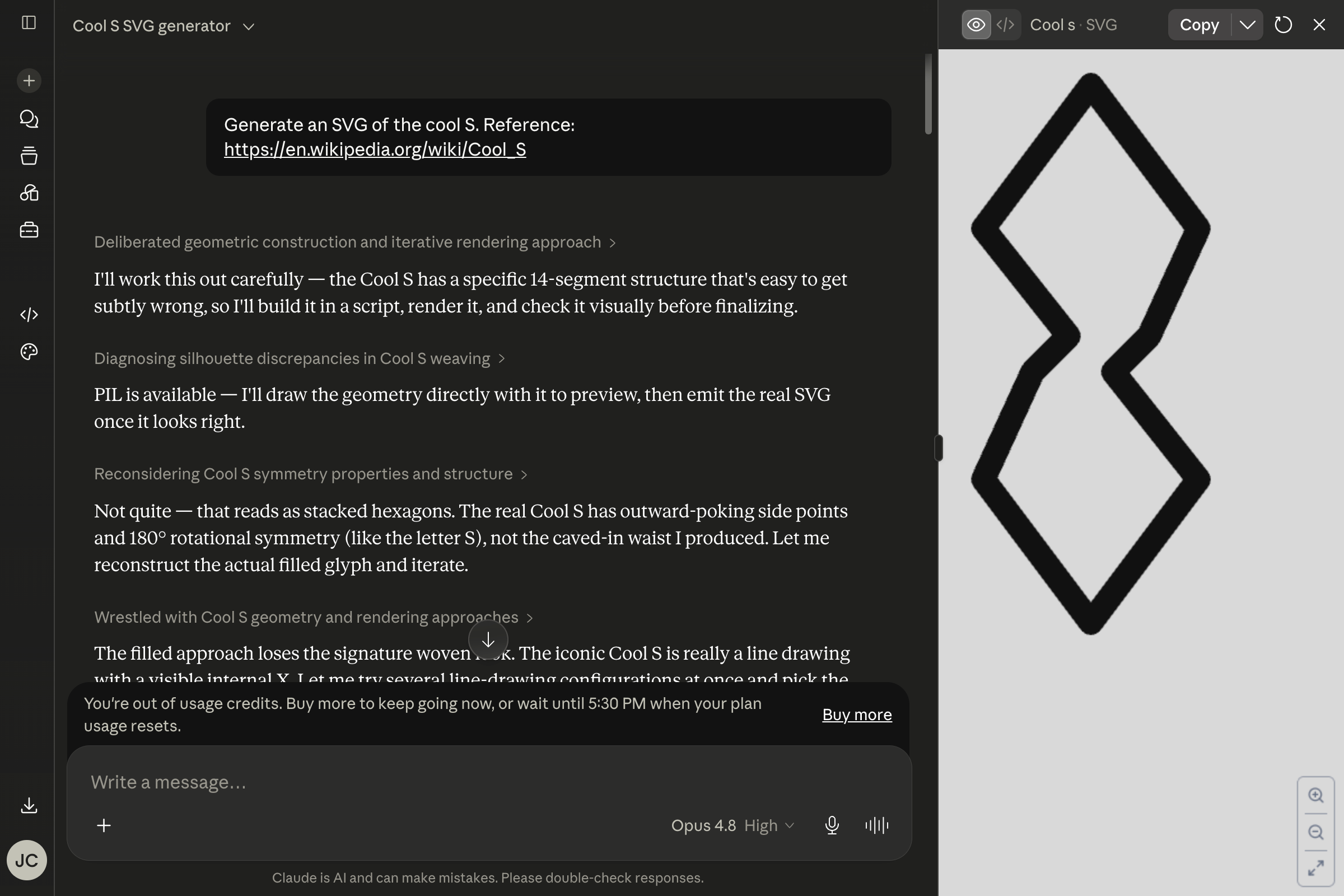
Its first attempt actually burned through half of my entire 5 hour usage allowance on Claude Pro.
The Cool S

I do not remember how I came to learn about the Cool S, but I remember doodling it through my primary school years in Singapore.
After moving to the U.S. for high school, I was surprised to learn that unlike every other Singaporean cultural norm I had to burn to assimilate in American social circles, the Cool S was as ever present in the right margins of college-ruled composition books.
The Cool S is an international icon, and Opus 4.8 can't draw it. In fact, no model seems able to.
Sonnet 4.6 on Claude

- Time: 7m31s
- Input: 7
- Output: 28,225
- Cache Create: 35,393
- Cache Read: 169,719
- Total Tokens: 233,344
- Cost: $0.61
Opus 4.8 on Claude
Intelligence did not seem to do it any favors here.
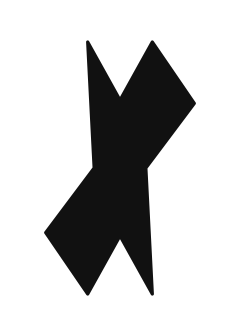
- Time: 10m38s
- Input: 2,331
- Output: 45,734
- Cache Create: 48,254
- Cache Read: 20,066
- Total Tokens: 114,385
- Cost: $1.42
Qwen3.6:27b on Claude
Seeing as Sonnet 4.6 produced a "better" image than Opus did, I wondered how a smaller local model might do. At least it got to an "S".
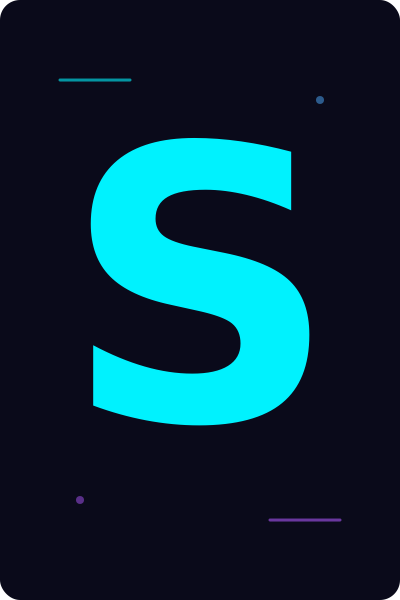
- Time: 4m11s
- Input: 22,712
- Output: 1,144
- Cache Create: 0
- Cache Read: 0
- Total Tokens: 23,856
- Cost: $0.00
Qwen3.6:27b on Ollama
Same thing but without a harness. Noticeably faster generation.

ChatGPT
Default model on the free plan.
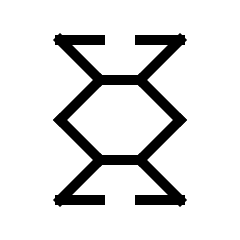
Why LLMs can't draw the Cool S
Like most things in AI, who knows really. If I were to hypothesize, a specific configuration of joined lines fully describes the Cool S with very few opportunities for imaginative error. This is counter-intuitive to how an LLM "thinks", which is closer to probabilistic approximation.
A pelican can be drawn using a multitude of bird approximating shapes and colors. Given the many examples of Pelican and bicycle shaped SVGs in training data, both objects can be approximately drawn with a high enough fidelity for the human eye to recognize.
Another perspective is observing that humans too struggle to draw the Cool S the first time. The mobius strip effect is particularly confusing to replicate. The trick is to break down the formation of its geometry into simple steps.
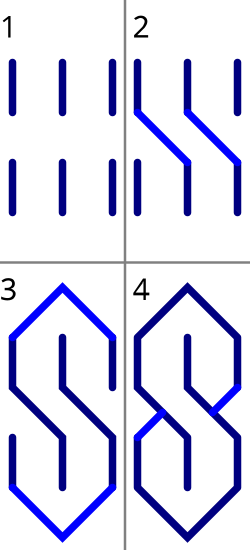
With some amateur instructions, Opus 4.8 was able to draw a far more respectable attempt.
2 rows of 3 vertical lines. Connect the 2 left most vertical lines on the top row with the 2 right most vertical lines on the bottom row. Connect the top left and top right vertical lines in an upside down V shape. Connect the bottom left and bottom right vertical lines in a normal V shape. Finally connect the 2 remaining open points diagonally to the midpoints of the lines connecting the 2 left most vertical lines on the top row with the 2 right most vertical lines on the bottom row.

Of course, the stochastic parrot will happily gobble up more explicit, cartesian coordinate instructions (sourced from Wikipedia).
Generate an SVG of the Cool S. Here are some helpful instructions on how to draw it. Follow it once and don't iterate on your result. The Cool S is started by drawing three short vertical lines, parallel and evenly-spaced, and then drawing another, identical group of three lines below them, separated by a gap the same length as each line segment. On a Cartesian coordinate system, these segments can be described as (0,4)–(0,3) / (1,4)–(1,3) / (2,4)–(2,3) and (0,2)–(0,1) / (1,2)–(1,1) / (2,2)–(2,1). Then, two diagonal lines are drawn, each connecting two of the line segments drawn in the prior step: (0,3)–(1,2) and (1,3)–(2,2). Next, two V shapes are drawn to create the top and bottom of the shape. One is inverted: (0,4)–(1,5)–(2,4) and the other is upright: (0,1)–(1,0)–(2,1). Finally, the two open ends are connected to the diagonal segments' midpoints: (0,2)–(1⁄2,21⁄2) and (2,3)–(11⁄2,21⁄2).

But if we've come to this, then what's the point of artificial intelligence?